
Tr

Archive for August, 2026

What Should You Look for in Final-Mile Delivery Management Software?

Choosing delivery management software is one of the most important technology decisions a carrier can make. The right platform should do more than dispatch drivers. It should improve efficiency, provide operational visibility, and support long-term business growth.

With dozens of solutions available, understanding which features truly matter can help you make a more informed decision.

Route Optimization

Efficient routing reduces mileage, fuel costs, and delivery times. Look for software that automatically optimizes routes while allowing dispatchers to make manual adjustments when needed.

Real-Time Dispatch Management

Your dispatch team should have complete visibility into every order, driver, and route from a single dashboard.

Key capabilities include:

  • Live driver tracking
  • Route monitoring
  • Exception management
  • Driver messaging
  • Automatic status updates

Mobile Driver Application

Drivers need more than navigation.

A modern mobile app should include:

  • Barcode scanning
  • Electronic signatures
  • Photo proof of delivery
  • GPS verification
  • Delivery notes
  • Customer communication

Customer Visibility

Customers increasingly expect transparency throughout the delivery process.

Look for features such as:

  • Live tracking
  • Automated notifications
  • Accurate ETAs
  • Delivery confirmations
  • Self-service delivery updates

Reporting and Analytics

Good software helps you improve over time.

Track metrics such as:

  • On-time delivery percentage
  • Driver productivity
  • Delivery exceptions
  • Customer service trends

Scalability

The software you choose today should still work as your business grows.

Ask:

  • Can it support additional drivers?
  • Can it handle increased delivery volume?
  • Can new locations be added?
  • Can workflows be customized?
  • Can additional systems be integrated?

Implementation and Support

Technology is only valuable if your team can successfully use it.

Ask potential providers about:

  • Implementation
  • Live Training
  • 24/7 Customer support
  • Product updates
  • Data migration
  • Integration support

Why It Matters

The most successful carriers aren’t simply buying software; they’re investing in a platform that improves every stage of the delivery lifecycle.

Key Software Systems’ Xcelerator and MobileTek combine dispatch, route optimization, driver management, customer communication, billing, analytics, and integrations into one comprehensive solution designed specifically for final-mile operations.

Frequently Asked Questions

What is the most important feature in delivery management software?
There is no single feature that matters most for every carrier. Route optimization, dispatch management, driver tools, visibility, integrations, and reporting are all important components.

How much does delivery management software cost?
Pricing varies based on the provider, number of users or drivers, features, integrations, and implementation requirements.

Should delivery software include a driver app?
Yes. A mobile driver application creates a direct connection between drivers and dispatch while providing real-time delivery information.

Can delivery management software replace a TMS?
In some operations, a comprehensive delivery management platform can handle many of the functions traditionally associated with a TMS. The right choice depends on the carrier’s specific transportation requirements.

How long does it take to implement delivery software?
Implementation timelines vary depending on the complexity of the operation, integrations, data migration, customization, and training requirements.
What Is Last-Mile Delivery Software and How Does It Work?

Last-mile delivery software is technology that helps companies plan, manage, track, and optimize the final stage of the delivery process. It connects dispatchers, drivers, customers, and business systems to help deliveries move efficiently from the distribution point to the destination.

For final-mile carriers managing multiple drivers, routes, customers, and delivery requirements, the right software can replace disconnected systems and manual processes with a centralized platform.

What Does Last-Mile Delivery Software Do?

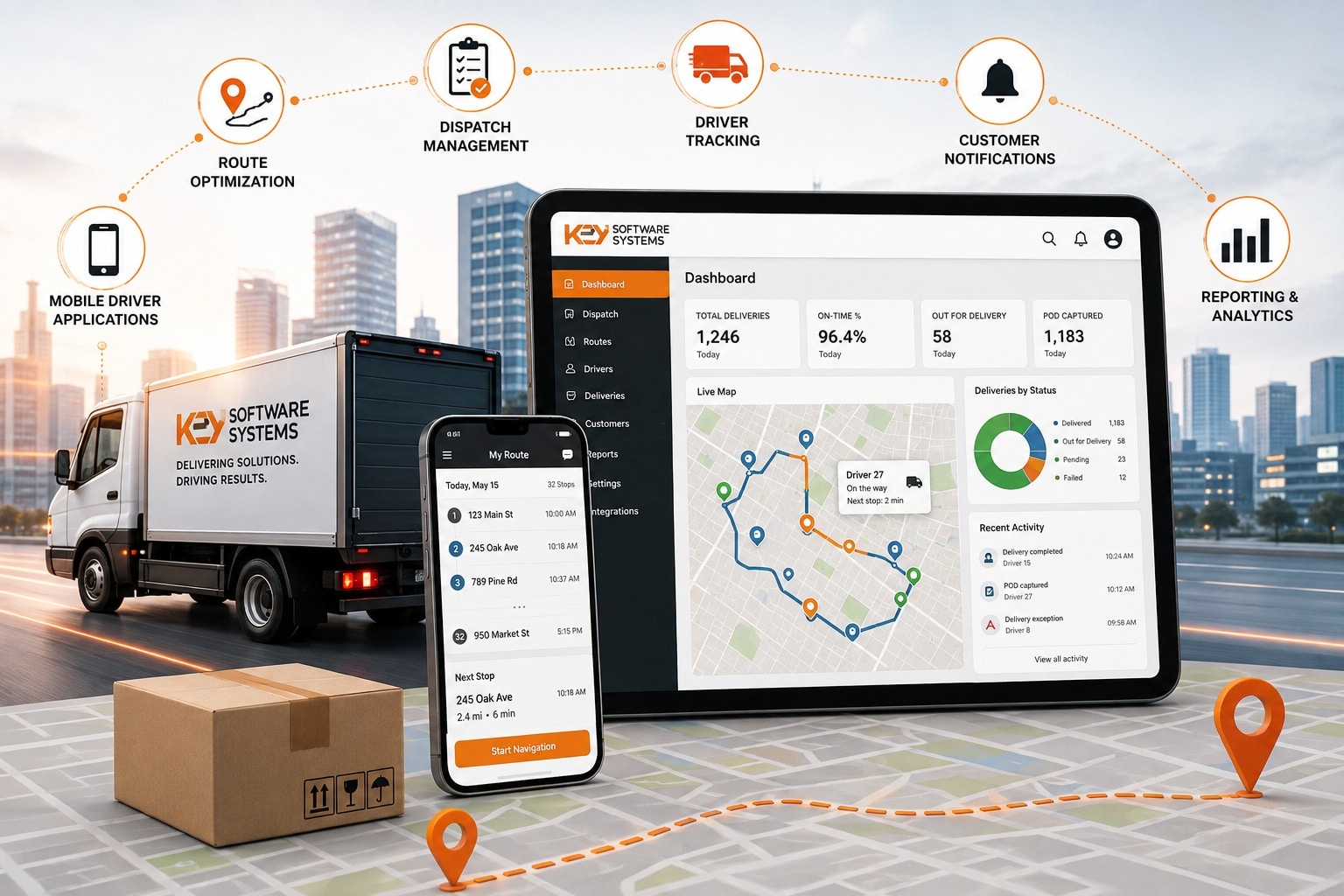
A modern delivery management platform typically brings several important functions together, including:

  • Route planning and optimization
  • Dispatch management
  • Driver tracking
  • Mobile driver applications
  • Electronic proof of delivery
  • Customer notifications
  • Delivery scheduling
  • Billing and settlements
  • Reporting and analytics
  • System integrations

Instead of managing these processes separately, dispatchers can access the information they need from one centralized system.

How Does It Work?

The process typically begins when an order enters the system.

The software captures important information such as the delivery address, service requirements, requested delivery time, package details, and customer information.

The system can then organize deliveries into efficient routes based on factors such as:

  • Geographic location
  • Driver availability
  • Vehicle capacity
  • Delivery windows
  • Service requirements
  • Route restrictions
  • Driver working areas

Once routes are created, dispatchers can monitor progress and adjust as conditions change.

What Does the Driver Use?

A mobile driver application connects the driver to the dispatch operation.

Depending on the platform, drivers can use their mobile device to:

  • View their route and stop sequence
  • Scan packages
  • Capture signatures
  • Take photos for proof of delivery
  • Update delivery statuses
  • Record exceptions
  • Communicate with dispatch
  • Navigate to stops

This eliminates many manual processes and gives dispatchers greater visibility of what is happening in the field.

How Does It Improve Customer Service?

Customers increasingly expect visibility into their deliveries.

Delivery management software can provide automated notifications, estimated arrival times, tracking information, delivery confirmations, and other updates without requiring dispatchers or customer service representatives to manually provide every status update.

Who Uses Last-Mile Delivery Software?

Last-mile delivery software can be used by a wide range of organizations, including:

  • Courier companies
  • Final-mile carriers
  • Medical and healthcare delivery companies
  • Retail delivery operations
  • Furniture and appliance delivery companies
  • 3PLs
  • B2B distributors
  • E-commerce delivery operations

Why Is It Important?

As delivery volumes increase, managing operations manually becomes increasingly difficult.

Last-mile delivery software helps businesses improve route efficiency, reduce unnecessary mileage, increase driver productivity, improve visibility, and provide a better customer experience.

How Key Software Systems Helps

Key Software Systems’ Xcelerator and MobileTek platform brings the major components of final-mile delivery management together in one system.

From route optimization and dispatch to driver management, customer communication, billing, reporting, and integrations, Xcelerator and MobileTek are designed to help final-mile businesses manage the complete delivery lifecycle.

Frequently Asked Questions

What is last-mile delivery software?
It is software designed to help businesses plan, dispatch, track, and manage deliveries from a distribution point to the final customer.

Is last-mile delivery software the same as a TMS?
Not necessarily. A TMS can manage broader transportation operations, while last-mile delivery software focuses specifically on the processes involved in completing deliveries.

Can small delivery companies use last-mile software?
Yes. Delivery management software can help organizations of many sizes improve efficiency and establish processes that can scale as the business grows.

Does delivery software track drivers?
Many platforms provide real-time driver visibility using GPS and mobile applications.

Can delivery software integrate with other systems?
Yes. Modern platforms commonly provide APIs and other integration tools to connect with ERP, warehouse, e-commerce, accounting, and other business systems.

How Can Final-Mile Carriers Improve On-Time Delivery?

On-time delivery is one of the most important performance measures for a final-mile carrier. Improving on-time performance requires more than simply telling drivers to move faster. It depends on accurate planning, efficient routing, real-time visibility, effective communication, and the ability to respond quickly when something goes wrong.

  1. Start With Better Route Planning

Poorly planned routes can create unnecessary mileage, longer drive times, and miss delivery windows.

Route optimization software can evaluate delivery locations, time windows, driver availability, vehicle capacity, and other constraints to create more efficient routes.

  1. Give Drivers the Right Information

Drivers need accurate information before they leave the facility.

A mobile driver application can provide:

  • Stop sequences
  • Customer information
  • Delivery instructions
  • Navigation
  • Package information
  • Special service requirements
  • Real-time status updates

When drivers have the information they need, fewer delays occur in the field.

  1. Monitor Routes in Real Time

Planning the perfect route in the morning does not guarantee a perfect day.

Traffic, weather, customer delays, vehicle problems, and unexpected delivery issues can change the plan.

Real-time visibility allows dispatchers to identify problems early and adjust before a small delay becomes a missed delivery window.

  1. Improve Customer Communication

Customers are less likely to be frustrated when they know what is happening.

Automated notifications can provide information such as:

  • Delivery confirmation
  • Estimated arrival times
  • Driver status
  • Delivery delays
  • Proof of delivery

Better communication can also reduce the number of calls coming into customer service.

  1. Track Delivery Performance

You cannot improve what you do not measure.

Important metrics include:

  • On-time delivery percentage
  • Average delivery time
  • Stops per route
  • Cost per stop
  • Miles per delivery
  • Failed delivery percentage
  • Driver productivity

Analyzing these metrics can reveal where operational improvements are needed.

  1. Identify the Cause of Missed Deliveries

The missed delivery is not necessarily the root problem.

Carriers should determine why deliveries are late.

Common causes include:

  • Inefficient routes
  • Incorrect addresses
  • Traffic
  • Driver shortages
  • Vehicle issues
  • Customer availability
  • Inaccurate delivery windows
  • Poor communication

Understanding the cause makes it possible to address the underlying issue.

How Key Software Systems Supports On-Time Delivery

Xcelerator and MobileTek provide final-mile carriers with tools for route optimization, dispatch management, driver visibility, mobile workflows, customer communication, and reporting.

By connecting these processes, carriers can improve operational visibility and make faster decisions throughout the delivery day.

Frequently Asked Questions

What is a good on-time delivery percentage?
The appropriate target depends on the industry, service level, and customer commitments. Carriers should establish benchmarks based on their specific operation and continuously work to improve them.

How does route optimization improve on-time delivery?
It helps create efficient routes while accounting for factors such as delivery windows, locations, driver availability, and other operational constraints.

Can technology reduce failed deliveries?
Yes. Better address information, customer communication, delivery scheduling, driver instructions, and real-time visibility can all help reduce failed attempts.

How should a carrier measure on-time performance?
Track deliveries against the promised or scheduled delivery window and analyze performance by driver, route, customer, service type, and location.

Key Software Systems TrustIndex Reviews Stars Key Software Systems TrustIndex Reviews Badge