
Tr

Archive for the
‘All’ Category

What Should You Look for in Final-Mile Delivery Management Software?

Choosing delivery management software is one of the most important technology decisions a carrier can make. The right platform should do more than dispatch drivers. It should improve efficiency, provide operational visibility, and support long-term business growth.

With dozens of solutions available, understanding which features truly matter can help you make a more informed decision.

Route Optimization

Efficient routing reduces mileage, fuel costs, and delivery times. Look for software that automatically optimizes routes while allowing dispatchers to make manual adjustments when needed.

Real-Time Dispatch Management

Your dispatch team should have complete visibility into every order, driver, and route from a single dashboard.

Key capabilities include:

  • Live driver tracking
  • Route monitoring
  • Exception management
  • Driver messaging
  • Automatic status updates

Mobile Driver Application

Drivers need more than navigation.

A modern mobile app should include:

  • Barcode scanning
  • Electronic signatures
  • Photo proof of delivery
  • GPS verification
  • Delivery notes
  • Customer communication

Customer Visibility

Customers increasingly expect transparency throughout the delivery process.

Look for features such as:

  • Live tracking
  • Automated notifications
  • Accurate ETAs
  • Delivery confirmations
  • Self-service delivery updates

Reporting and Analytics

Good software helps you improve over time.

Track metrics such as:

  • On-time delivery percentage
  • Driver productivity
  • Delivery exceptions
  • Customer service trends

Scalability

The software you choose today should still work as your business grows.

Ask:

  • Can it support additional drivers?
  • Can it handle increased delivery volume?
  • Can new locations be added?
  • Can workflows be customized?
  • Can additional systems be integrated?

Implementation and Support

Technology is only valuable if your team can successfully use it.

Ask potential providers about:

  • Implementation
  • Live Training
  • 24/7 Customer support
  • Product updates
  • Data migration
  • Integration support

Why It Matters

The most successful carriers aren’t simply buying software; they’re investing in a platform that improves every stage of the delivery lifecycle.

Key Software Systems’ Xcelerator and MobileTek combine dispatch, route optimization, driver management, customer communication, billing, analytics, and integrations into one comprehensive solution designed specifically for final-mile operations.

Frequently Asked Questions

What is the most important feature in delivery management software?
There is no single feature that matters most for every carrier. Route optimization, dispatch management, driver tools, visibility, integrations, and reporting are all important components.

How much does delivery management software cost?
Pricing varies based on the provider, number of users or drivers, features, integrations, and implementation requirements.

Should delivery software include a driver app?
Yes. A mobile driver application creates a direct connection between drivers and dispatch while providing real-time delivery information.

Can delivery management software replace a TMS?
In some operations, a comprehensive delivery management platform can handle many of the functions traditionally associated with a TMS. The right choice depends on the carrier’s specific transportation requirements.

How long does it take to implement delivery software?
Implementation timelines vary depending on the complexity of the operation, integrations, data migration, customization, and training requirements.
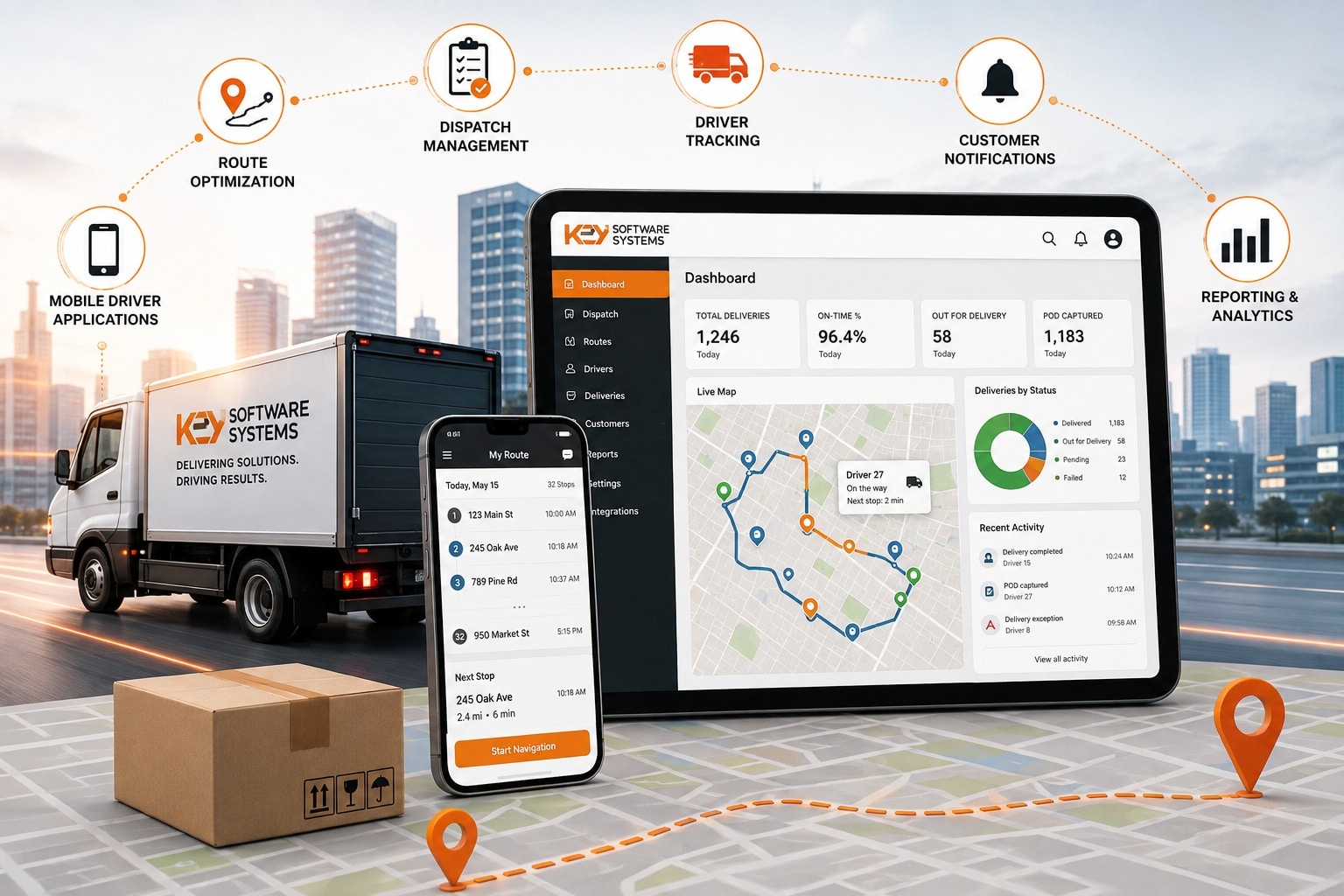

What Is Last-Mile Delivery Software and How Does It Work?

Last-mile delivery software is technology that helps companies plan, manage, track, and optimize the final stage of the delivery process. It connects dispatchers, drivers, customers, and business systems to help deliveries move efficiently from the distribution point to the destination.

For final-mile carriers managing multiple drivers, routes, customers, and delivery requirements, the right software can replace disconnected systems and manual processes with a centralized platform.

What Does Last-Mile Delivery Software Do?

A modern delivery management platform typically brings several important functions together, including:

  • Route planning and optimization
  • Dispatch management
  • Driver tracking
  • Mobile driver applications
  • Electronic proof of delivery
  • Customer notifications
  • Delivery scheduling
  • Billing and settlements
  • Reporting and analytics
  • System integrations

Instead of managing these processes separately, dispatchers can access the information they need from one centralized system.

How Does It Work?

The process typically begins when an order enters the system.

The software captures important information such as the delivery address, service requirements, requested delivery time, package details, and customer information.

The system can then organize deliveries into efficient routes based on factors such as:

  • Geographic location
  • Driver availability
  • Vehicle capacity
  • Delivery windows
  • Service requirements
  • Route restrictions
  • Driver working areas

Once routes are created, dispatchers can monitor progress and adjust as conditions change.

What Does the Driver Use?

A mobile driver application connects the driver to the dispatch operation.

Depending on the platform, drivers can use their mobile device to:

  • View their route and stop sequence
  • Scan packages
  • Capture signatures
  • Take photos for proof of delivery
  • Update delivery statuses
  • Record exceptions
  • Communicate with dispatch
  • Navigate to stops

This eliminates many manual processes and gives dispatchers greater visibility of what is happening in the field.

How Does It Improve Customer Service?

Customers increasingly expect visibility into their deliveries.

Delivery management software can provide automated notifications, estimated arrival times, tracking information, delivery confirmations, and other updates without requiring dispatchers or customer service representatives to manually provide every status update.

Who Uses Last-Mile Delivery Software?

Last-mile delivery software can be used by a wide range of organizations, including:

  • Courier companies
  • Final-mile carriers
  • Medical and healthcare delivery companies
  • Retail delivery operations
  • Furniture and appliance delivery companies
  • 3PLs
  • B2B distributors
  • E-commerce delivery operations

Why Is It Important?

As delivery volumes increase, managing operations manually becomes increasingly difficult.

Last-mile delivery software helps businesses improve route efficiency, reduce unnecessary mileage, increase driver productivity, improve visibility, and provide a better customer experience.

How Key Software Systems Helps

Key Software Systems’ Xcelerator and MobileTek platform brings the major components of final-mile delivery management together in one system.

From route optimization and dispatch to driver management, customer communication, billing, reporting, and integrations, Xcelerator and MobileTek are designed to help final-mile businesses manage the complete delivery lifecycle.

Frequently Asked Questions

What is last-mile delivery software?
It is software designed to help businesses plan, dispatch, track, and manage deliveries from a distribution point to the final customer.

Is last-mile delivery software the same as a TMS?
Not necessarily. A TMS can manage broader transportation operations, while last-mile delivery software focuses specifically on the processes involved in completing deliveries.

Can small delivery companies use last-mile software?
Yes. Delivery management software can help organizations of many sizes improve efficiency and establish processes that can scale as the business grows.

Does delivery software track drivers?
Many platforms provide real-time driver visibility using GPS and mobile applications.

Can delivery software integrate with other systems?
Yes. Modern platforms commonly provide APIs and other integration tools to connect with ERP, warehouse, e-commerce, accounting, and other business systems.

How Can Final-Mile Carriers Improve On-Time Delivery?

On-time delivery is one of the most important performance measures for a final-mile carrier. Improving on-time performance requires more than simply telling drivers to move faster. It depends on accurate planning, efficient routing, real-time visibility, effective communication, and the ability to respond quickly when something goes wrong.

  1. Start With Better Route Planning

Poorly planned routes can create unnecessary mileage, longer drive times, and miss delivery windows.

Route optimization software can evaluate delivery locations, time windows, driver availability, vehicle capacity, and other constraints to create more efficient routes.

  1. Give Drivers the Right Information

Drivers need accurate information before they leave the facility.

A mobile driver application can provide:

  • Stop sequences
  • Customer information
  • Delivery instructions
  • Navigation
  • Package information
  • Special service requirements
  • Real-time status updates

When drivers have the information they need, fewer delays occur in the field.

  1. Monitor Routes in Real Time

Planning the perfect route in the morning does not guarantee a perfect day.

Traffic, weather, customer delays, vehicle problems, and unexpected delivery issues can change the plan.

Real-time visibility allows dispatchers to identify problems early and adjust before a small delay becomes a missed delivery window.

  1. Improve Customer Communication

Customers are less likely to be frustrated when they know what is happening.

Automated notifications can provide information such as:

  • Delivery confirmation
  • Estimated arrival times
  • Driver status
  • Delivery delays
  • Proof of delivery

Better communication can also reduce the number of calls coming into customer service.

  1. Track Delivery Performance

You cannot improve what you do not measure.

Important metrics include:

  • On-time delivery percentage
  • Average delivery time
  • Stops per route
  • Cost per stop
  • Miles per delivery
  • Failed delivery percentage
  • Driver productivity

Analyzing these metrics can reveal where operational improvements are needed.

  1. Identify the Cause of Missed Deliveries

The missed delivery is not necessarily the root problem.

Carriers should determine why deliveries are late.

Common causes include:

  • Inefficient routes
  • Incorrect addresses
  • Traffic
  • Driver shortages
  • Vehicle issues
  • Customer availability
  • Inaccurate delivery windows
  • Poor communication

Understanding the cause makes it possible to address the underlying issue.

How Key Software Systems Supports On-Time Delivery

Xcelerator and MobileTek provide final-mile carriers with tools for route optimization, dispatch management, driver visibility, mobile workflows, customer communication, and reporting.

By connecting these processes, carriers can improve operational visibility and make faster decisions throughout the delivery day.

Frequently Asked Questions

What is a good on-time delivery percentage?
The appropriate target depends on the industry, service level, and customer commitments. Carriers should establish benchmarks based on their specific operation and continuously work to improve them.

How does route optimization improve on-time delivery?
It helps create efficient routes while accounting for factors such as delivery windows, locations, driver availability, and other operational constraints.

Can technology reduce failed deliveries?
Yes. Better address information, customer communication, delivery scheduling, driver instructions, and real-time visibility can all help reduce failed attempts.

How should a carrier measure on-time performance?
Track deliveries against the promised or scheduled delivery window and analyze performance by driver, route, customer, service type, and location.

How Does Collaboration Shape the Future of Delivery Management Technology?

Customer-Driven Innovation

The best innovations in technology rarely happen alone. While research, development, and strategic planning are essential, some of the most impactful advancements begin with something much simpler: a conversation.

At Key Software Systems, innovation is fueled by the real-world experiences of the businesses that rely on our technology every day. From courier companies and final-mile delivery providers to logistics organizations and transportation professionals, our customers play a critical role in shaping the future of our software solutions.

Why Customer Feedback Drives Better Technology

The delivery and logistics industry is constantly evolving. New customer expectations, operational challenges, workforce demands, and market pressures require technology providers to stay ahead of the curve.

The most effective way to accomplish that is by listening.

Every day, our customers share valuable insights about their operations. They ask questions, identify opportunities for improvement, discuss industry challenges, and provide feedback on how technology can better support their businesses. These conversations help us understand what matters most to carriers, dispatchers, customer service teams, drivers, and business leaders.

Rather than simply responding to industry trends, we work directly with our customers to develop solutions that address real operational needs.

Building Better Delivery Management Software Together

Many of the enhancements and innovations within Xcelerator, our comprehensive delivery management and transportation management platform, originate from customer collaboration.

Whether it’s improving dispatch workflows, enhancing route optimization capabilities, streamlining reporting, increasing visibility, or automating manual processes, customer feedback helps guide our product roadmap.

This collaborative approach ensures that every new feature is designed with practical application in mind. Instead of building technology based on assumptions, we build solutions informed by the people who use them every day.

The result is a platform that continually evolves alongside the industry it serves.

Turning Challenges into Opportunities

Some of the best ideas emerge when customers share the obstacles they’re facing.

A dispatch manager may highlight a workflow bottleneck. A carrier may identify a need for greater visibility. A logistics provider may suggest a new automation opportunity. These real-world challenges often become the foundation for future enhancements that benefit our entire customer community.

By maintaining an open dialogue with our customers, we’re able to identify emerging needs early and develop innovative solutions that help businesses operate more efficiently, scale more effectively, and deliver better service.

A Partnership Beyond Software

Technology is most successful when it is built through partnership.

At Key Software Systems, we view our customers as collaborators in the innovation process. Their expertise, experience, and feedback help us create smarter tools, stronger workflows, and more powerful solutions for the transportation and logistics industry.

Our philosophy is simple:

You ask. We listen. Then we build together.

That ongoing collaboration continues to shape Xcelerator and the future of delivery management technology.

Looking Ahead

As the logistics and final-mile delivery industry continues to evolve, customer-driven innovation will remain at the center of everything we do.

We’re grateful for every conversation, every suggestion, and every partnership that helps us improve our technology and better serve the industry.

Because great software starts with great ideas and great ideas often start with a conversation.

Why is Reporting and Visibility Critical for Modern Delivery Operations?

In today’s fast-paced logistics and final-mile delivery environment, operational success depends on more than simply moving packages from point A to point B. Behind every successful delivery operation is a back-office team responsible for managing customers, drivers, billing, settlements, performance metrics, and business growth.

To make informed decisions, those teams need one thing above all else: visibility.

The Challenge of Limited Operational Insight

Many delivery organizations struggle with fragmented reporting tools, disconnected data sources, and dashboards that only provide a partial view of business performance. When critical information is spread across multiple systems, administrators spend valuable time gathering data instead of acting on it.

Without comprehensive reporting, businesses face challenges such as:

  • Delayed decision-making
  • Limited visibility into operational performance
  • Difficulty tracking customer-specific metrics
  • Inefficient billing and settlement processes
  • Reduced ability to identify growth opportunities
  • Increased administrative workload

As delivery volumes increase and customer expectations rise, these challenges can quickly impact profitability and service quality.

How Advanced Reporting Improves Business Performance

Effective reporting transforms raw operational data into actionable insights. When managers and administrators have access to accurate, real-time information, they can identify trends, resolve issues faster, and make data-driven decisions that improve efficiency across the organization.

Key benefits of advanced reporting include:

Improved Operational Visibility

Comprehensive reporting provides a clear view of deliveries, drivers, routes, customer activity, financial performance, and operational trends. This visibility allows teams to proactively address issues before they affect service levels.

Faster Decision-Making

Access to real-time business intelligence helps managers quickly identify opportunities, monitor performance, and respond to changing operational conditions without waiting for manual reports.

Better Customer Service

Detailed reporting allows businesses to track service levels, delivery performance, and customer-specific metrics, helping teams maintain strong customer relationships and meet contractual requirements.

Increased Administrative Efficiency

Automated reporting reduces the time spent manually collecting and organizing data, allowing administrative teams to focus on higher-value activities.

Why Custom Reporting Matters

Every logistics operation is unique. Different customers, service offerings, delivery models, and workflows require different performance measurements.

That’s why flexibility in reporting is essential.

While standard reports provide valuable insights, many organizations need customized views that align with their specific business processes. The ability to tailor reports based on operational goals, customer requirements, or internal workflows creates a significant competitive advantage.

Custom reporting allows organizations to:

  • Track customer-specific KPIs
  • Monitor unique service offerings
  • Analyze profitability by account or route
  • Measure operational efficiency
  • Create reports tailored to management needs
  • Support strategic business planning

“I still remember us choosing Xcelerator and doing the conversion as it was one of my first big projects at CS Logistics. The relationships, value, and family atmosphere have been present the entire time.  Our business must be ever-changing, adaptable, and set on staying ahead of the curve.  Key Software Systems has been right by our side the entire time doing the exact same thing.  Our partnership has changed and evolved over the years, but it’s comforting knowing we have such a great teammate on our side.  Key Software Systems is always there with us trying to think outside the box, brainstorm, and solve problems.  Most recently, we partnered to kick the tires on incorporating a custom driver time and mileage audit tool we created internally into Xcelerator.  We are thrilled to see how we can tie everything together!” Mike Fuss | CS Logistics, Inc.

How Xcelerator Delivers Operational Intelligence

Xcelerator provides delivery companies with access to hundreds of built-in reports, offering immediate visibility in every area of the business.

From dispatch and routing to billing, driver settlements, customer activity, and financial performance, administrators can quickly access the information they need to manage operations effectively.

When standard reports don’t meet specific requirements, Xcelerator’s flexible reporting capabilities allow organizations to customize reports to match their exact workflows, customers, and business objectives.

This creates a reporting environment that adapts to the way your company operates rather than forcing your business to adapt to the software.

The Future of Logistics Management Is Data-Driven

As the delivery and logistics industry becomes increasingly competitive, organizations that leverage data effectively will be best positioned for growth.

Operational excellence isn’t achieved by adding more software tools. It’s achieved by gaining better visibility into the business and having the ability to turn that visibility into action.

With powerful reporting, customizable analytics, and complete operational insight, delivery organizations can make smarter decisions, improve efficiency, enhance customer service, and drive long-term success.

The businesses that win tomorrow will be the ones that can see clearly today.

How Can Final Mile Carriers Generate New Revenue Through Carrier Networks and Delivery Partnerships?

In today’s competitive final mile delivery landscape, growth often depends on finding new opportunities without significantly increasing operational costs. For carriers looking to expand their geographic reach, strengthen customer offerings, and create additional revenue streams, carrier collaboration networks are becoming an increasingly valuable strategy.

At Key Software Systems, we continue to see how connected delivery networks can help carriers work together to win more business, serve customers more effectively, and grow beyond traditional service boundaries.

Expanding Beyond Your Service Area Without Adding Overhead

One of the biggest challenges for regional and local delivery providers is balancing customer demands for broader coverage with the realities of operating costs. Opening new facilities, hiring additional drivers, and managing unfamiliar territories can be expensive and risky.

Through the Xcelerator carrier network, powered by Interconnect, carriers can instantly connect with trusted Xcelerator partners across the country. This allows companies to accept delivery opportunities outside their existing service areas while maintaining visibility, accountability, and operational control.

Instead of turning away business because a shipment falls outside a carrier’s coverage area, network participants can leverage partner carriers to complete deliveries efficiently and profitably.

Creating New Revenue Opportunities Through Collaboration

Carrier networks are more than just technology platforms; they create business development opportunities.

By participating in a connected carrier ecosystem, final mile providers can:

  • Increase exposure to delivery opportunities from other carriers
  • Expand service coverage into new regions and markets
  • Strengthening relationships with transportation partners
  • Improve customer retention by offering broader geographic reach
  • Generate additional revenue without significant infrastructure investments

As customer expectations continue to evolve, carriers that can offer flexible, scalable coverage often gain a competitive advantage.

Real-World Success Through Strategic Partnerships

A powerful example of this collaborative approach comes from Harold Boyett, President of Blue Streak Couriers. During a recent industry discussion, Harold shared how leveraging carrier partnerships and connected technology platforms has helped create meaningful business opportunities while strengthening relationships across the transportation community.

His experience highlights an important reality for today’s delivery providers: growth doesn’t have to come solely from expanding your own fleet or opening new locations. By working together through a connected carrier network, companies can extend their reach, serve customers more effectively, and create mutually beneficial partnerships that drive long-term success.

The combination of trusted carrier relationships and integrated technology creates a true win scenario for carriers, partners, and customers alike.

Building Win-Win Partnerships

Successful carrier partnerships through Interconnect and Nexus benefit everyone involved:

  • Shippers gain access to broader delivery coverage and dependable service.
  • Originating carriers can confidently support customer needs outside their service areas.
  • Partner carriers receive new business opportunities and revenue streams.

This collaborative approach creates stronger transportation networks while helping carriers grow their businesses in a sustainable way.

Industry leaders like Harold Boyett continue to demonstrate how combining technology, connectivity, and strategic partnerships can unlock opportunities that would be difficult to achieve independently.

The Future of Final Mile Growth

As the final mile industry increases, carriers that embrace collaborative networks will be better positioned to compete, scale, and meet growing customer demands.

Technology platforms that connect carriers, automate visibility, and facilitate partner relationships are no longer just operational tools, they are becoming growth engines.

For carriers looking to expand their reach, enter new markets, and generate new revenue opportunities, participating in a connected network may be one of the most effective ways to accelerate growth while maintaining operational efficiency.

Growth isn’t always about adding more resources. Sometimes it’s about building stronger connections.

Key Software Systems Recaps a Successful 2026 ECA MarketPlace Event

The 2026 ECA MarketPlace Event brought together some of the brightest minds in the transportation, courier, final-mile delivery, and logistics industries, and Key Software Systems was proud to be part of the experience.

We want to extend our sincere thanks to the Express Carriers Association (ECA) for hosting another exceptional event that created valuable opportunities for carriers, shippers, technology providers, and industry leaders to connect, collaborate, and grow.

Strengthening Relationships Across the Delivery Industry

One of the highlights of MarketPlace was the opportunity to meet face-to-face with customers, partners, and industry professionals from across the country. These conversations reinforced the importance of innovation, operational efficiency, and technology in helping final-mile delivery providers navigate today’s rapidly evolving logistics landscape.

Throughout the event, we heard firsthand how organizations are leveraging technology to improve dispatch operations, optimize routes, enhance customer visibility, and scale their delivery networks. Just as important, we were able to gain valuable insight into the challenges carriers continue to face and discuss solutions that can help drive long-term success.

Patrick Scardilli Appointed to ECA Board of Directors

This year’s event was especially meaningful for Key Software Systems as Patrick Scardilli, Vice President of Sales and Marketing, was appointed to the ECA Board of Directors.

Reflecting on the announcement, Patrick shared:

“I am honored to announce my appointment as the newest member of the ECA Board of Directors. No fluff, the ECA changed my life both professionally and personally. I’m humbled and look forward to working alongside a great group of industry leaders to help support the organization’s mission and the members it serves.”

Patrick’s appointment reflects his long-standing commitment to the delivery industry and further strengthens Key Software Systems’ involvement in helping carriers, logistics providers, and industry partners navigate growth, innovation, and operational excellence.

Collaboration Drives Industry Growth

What stood out most during the event was the spirit of collaboration. Whether discussing delivery automation, route optimization, driver management, customer experience, or network expansion, attendees shared a common goal: finding better ways to serve customers and strengthen their businesses.

The exchange of ideas, experiences, and best practices demonstrated why the courier, and final-mile delivery industry continues to thrive. Events like ECA MarketPlace create an environment where meaningful partnerships are formed and innovative solutions emerge.

Looking Ahead

The momentum generated at the 2026 ECA MarketPlace Event has made us excited for what’s ahead. We connected with many new organizations, strengthened existing partnerships, and explored opportunities to help carriers improve efficiency, visibility, and profitability through technology.

Why Does Customer Support Matters in Final Mile Delivery Software?

When evaluating final mile delivery software, courier software, or transportation management systems (TMS), many companies focus on features, automation, and pricing. While technology is critical, one factor often has a greater impact on long-term success: customer support.

At Key Software Systems, we believe that the people behind the technology are just as important as the technology itself.

What Should You Look for in a Delivery Management Software Provider?

Choosing a software provider is more than selecting a platform. You’re choosing a long-term partner that will support your operations, drivers, dispatchers, and customers every day.

The best delivery management software providers offer:

  • Live customer support
  • Fast response times
  • Personalized onboarding and training
  • Access to real experts
  • Ongoing partnership and consultation
  • Reliable technical assistance when issues arise

Unfortunately, many software companies have shifted toward outsourced support teams, automated phone systems, and self-service portals that leave customers searching for answers on their own.

How Does Key Software Systems Support Its Customers?

Key Software Systems has built its reputation by delivering responsive, personalized customer service to courier companies, last-mile carriers, medical couriers, distributors, and logistics providers across the country.

Live Personalized Software Demonstrations

Every operation is different.

Instead of generic presentations, our team provides live demonstrations tailored to each prospect’s unique workflows, delivery requirements, service areas, and business goals.

This allows companies to see exactly how Key Software’s Xcelerator delivery management platform can support their specific operation.

24/7 Live Customer Support

Delivery operations don’t stop at 5 PM, and neither do we.

Our customers have access to 24/7 live support from real people who understand the logistics industry. When issues arise, customers can speak directly with a team member instead of navigating endless automated menus or waiting days for a response.

Our Two-Ring Answer Policy

Time matters in logistics.

That’s why Key Software Systems maintains a two-ring answer policy. Our team is committed to answering calls quickly so customers can resolve issues and keep operations moving without unnecessary delays.

For courier companies, final mile carriers, and transportation providers, every minute counts.

One Team, One Location

Unlike many software companies that rely on outsourced departments or dispersed teams, Key Software Systems operates with its entire organization working together in one location.

This structure creates:

  • Faster communication
  • Better collaboration
  • Quicker problem resolution
  • Consistent customer experiences
  • Stronger accountability

When support, development, implementation, sales, and leadership work closely together, customers benefit from faster solutions and better service.

Why Customer Service Is a Competitive Advantage in Logistics Technology

Technology platforms can offer similar features such as route optimization, dispatch automation, driver management, proof of delivery, customer notifications, and billing tools.

What often separates a successful software partnership from a frustrating one is the quality of support behind the platform.

A software provider should be more than a vendor. They should be trusted partners invested in your success.

At Key Software Systems, we continue to invest in personal relationships, responsive support, and customer success because we know that software alone doesn’t solve problems—people do.

The Bottom Line

When selecting final mile delivery software, courier management software, or transportation management technology, don’t evaluate features alone.

Evaluate the people behind the platform.

“When we formed Take 2 Logistics, we had an “impossible” task of being ready to operate in just over 3 weeks.  The team at Key Software (led by Dave and Nick) were amazing.  They made the impossible very possible.  We were ready for operating with days to spare. The Key team was engaged in our business model and responsive to our needs.  They made sure we were ready to go.   Our team learned the software quickly and we were fully prepared to provide exceptional service to our customers.   

I appreciate the entire team with our implementation.  I further appreciate all the work that went into having a software system that is user friendly, customer-focused, and makes us a better company.” Lance Dearborn CEO | Take 2 Logistics

At Key Software Systems, we’ve built our business by listening to customers, solving problems, and being available when it matters most. While many providers have moved toward automated systems and outsourced support, we remain committed to delivering the personal service and responsiveness our customers deserve.

Because in logistics, technology matters but the people behind the technology matter even more.

Frequently Asked Questions Page

Does Key Software Systems offer live customer support?

Yes. Key Software Systems provides 24/7 live customer support with direct access to knowledgeable team members.

Does Key Software Systems use outsourced support?

No. Our team operates together from a single location, allowing for stronger collaboration and faster issue resolution.

How quickly does Key Software Systems answer support calls?

We maintain a two-ring answer policy to ensure customers receive assistance as quickly as possible.

Does Key Software Systems provide personalized software demonstrations?

Yes. Every demo is customized to the prospect’s business requirements, workflows, and operational goals.

Exciting news! Patrick Scardilli from Key Software Systems has been named the newest member of the ECA: A Delivery Industry Alliance Board of Directors 👏

I am honored to announce my appointment as the newest member of the ECA Board of Directors, ECA: A Delivery Industry Alliance.

patrick scardilli eca board of directors key software systems

No fluff, the ECA changed my life both professionally and personally. I’m humbled and look forward to working alongside a great group of industry leaders to help support the organization’s mission and members it serves.


Key Software Systems TrustIndex Reviews Stars Key Software Systems TrustIndex Reviews Badge